



Japan (EN)
Select your region or country.
Development of X-ray imaging technology and structural analysis of materials using ORCA®-Quest 2
Published on December 10, 2025
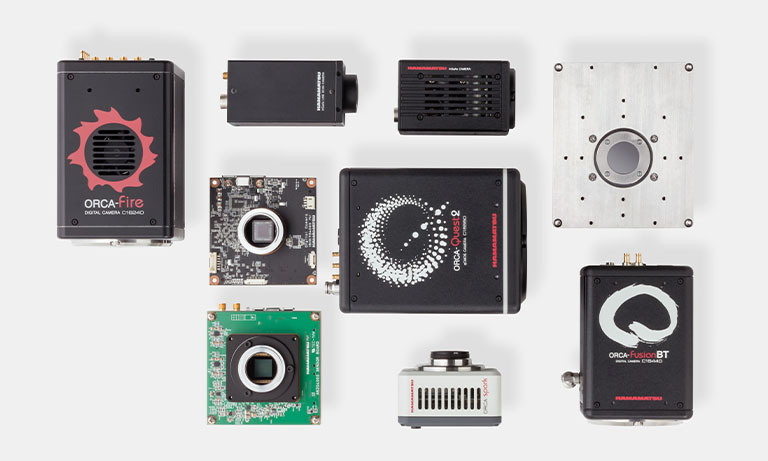
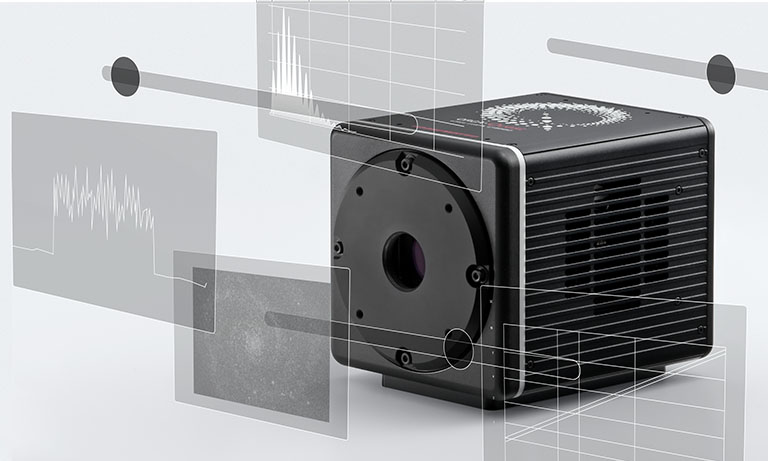
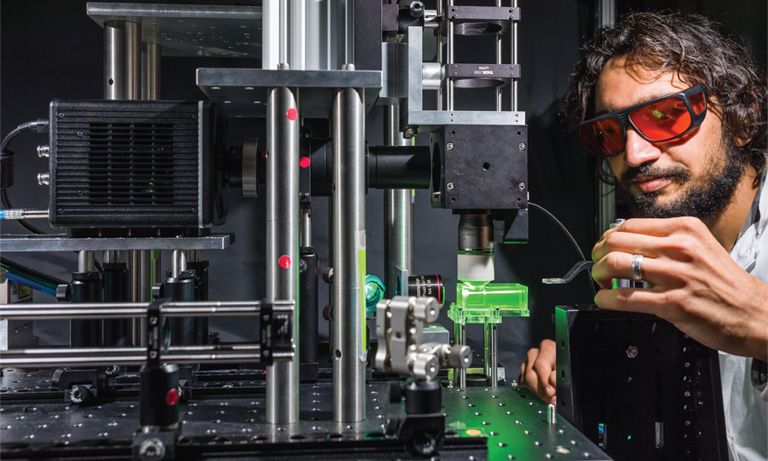
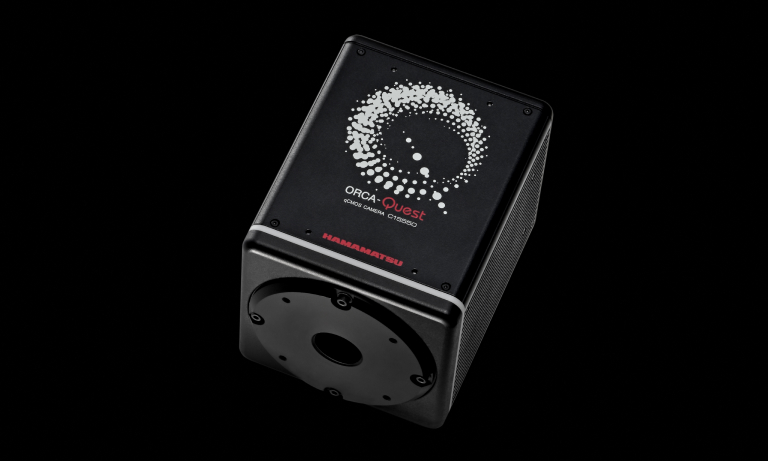
At the International Center for Synchrotron Radiation Innovation Smart (SRIS) of Tohoku University, cutting-edge imaging technologies are being developed by leveraging the next-generation synchrotron radiation facility “NanoTerasu.” The X-ray imaging system installed in the center’s “Spatio-Temporal Imaging Smart Lab” employs our ORCA-Quest 2 qCMOS® camera as its detector.
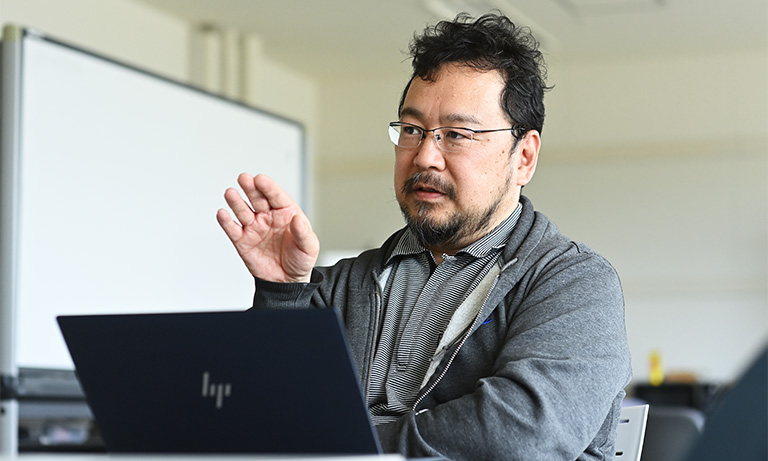
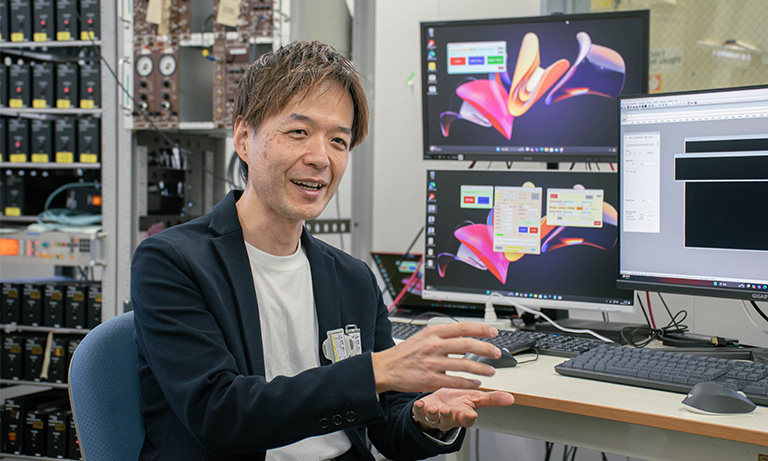
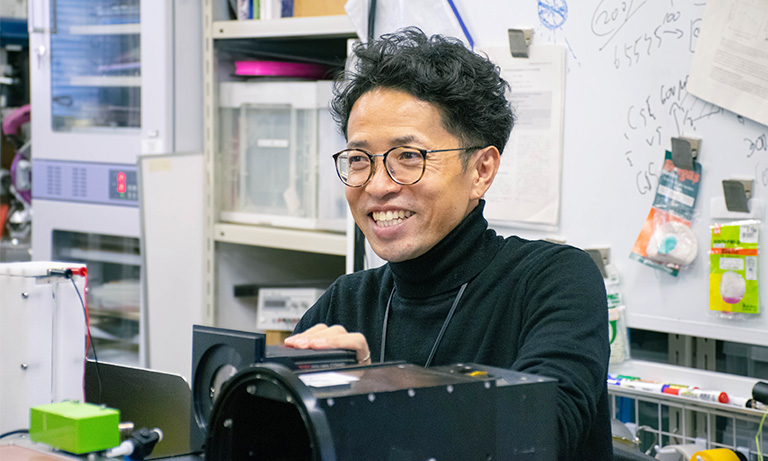
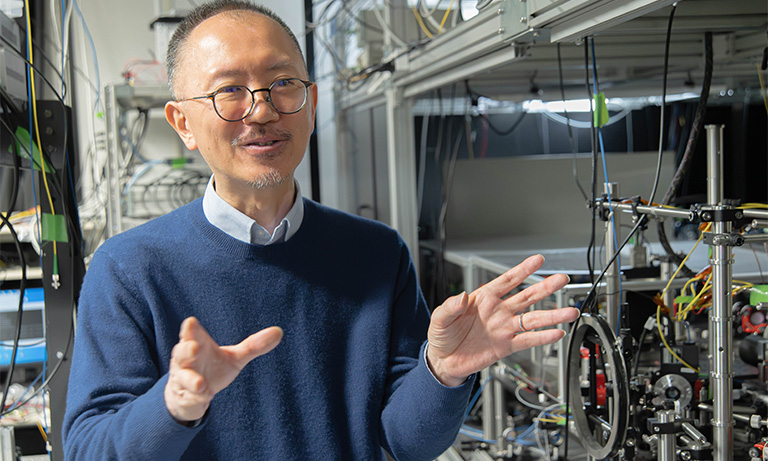
Dr. Wataru Yashiro, a member of the Spatio-Temporal Imaging Smart Lab, has integrated the ORCA-Quest 2 qCMOS camera into the NanoTerasu beamline to conduct a variety of experiments. We interviewed Dr. Yashiro to learn more about his research, the outcomes achieved through the adoption of ORCA-Quest 2, and the future of his research.
Current research
- Could you tell us about your research?
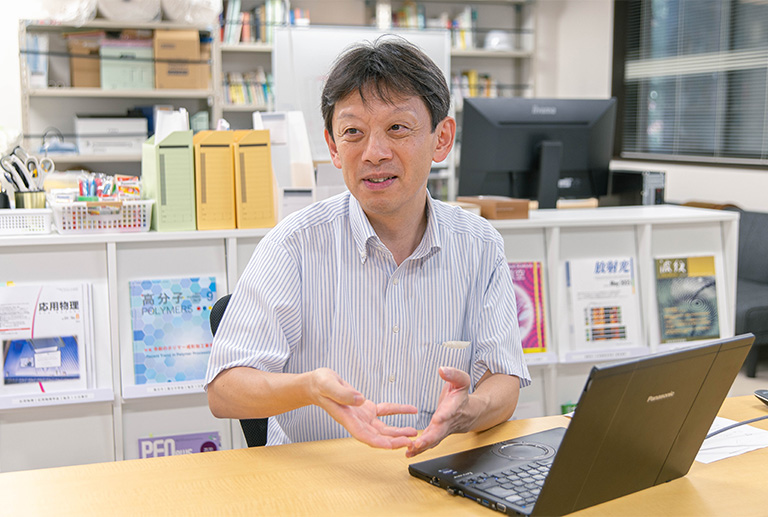
At the Spatio-Temporal Imaging Smart Lab of the SRIS at Tohoku University, we conduct research under the theme of “Pioneering the Frontier of the 4D World” using state-of-the-art synchrotron radiation technologies. Recently, our focus has been on developing 4D X-ray CT with millisecond time resolution, X-ray elastography, and integrated techniques that combine X-ray imaging with structural analysis. A constant challenge in all these areas is how to acquire highly detailed images.
Obtaining high-resolution images is truly an “endless pursuit.” To achieve advanced imaging, it is essential to develop the underlying technologies that support imaging itself. Therefore, our efforts are not limited to imaging techniques alone—we also work on the research and development of fundamental technologies such as optical components and systems that form the basis of imaging.
Challenges in synchrotron radiation imaging
- What are the challenges in advancing synchrotron radiation imaging research?

In high-speed X-ray imaging, the challenge lies in achieving even faster acquisition speeds, whereas in cases where speed is not critical, the focus shifts to achieving higher resolution. Each development path presents its own set of challenges. Focusing on high-resolution X-ray imaging, where we use Hamamatsu Photonics' cameras, one key issue is that increasing spatial resolution inevitably narrows the field of view. While higher spatial resolution enables the identification of fine structures, it also requires reducing the size of the object being observed. The reverse is also true: if we could image larger objects at high resolution, the scope of observation would naturally expand, providing a foundation for diverse academic and industrial applications. However, these performance factors are inherently in a trade-off relationship, which makes this a persistent challenge from an imaging perspective.
Of course, image quality is influenced not only by the camera but also by the X-ray source and optical systems. Therefore, it is essential to take a comprehensive approach when addressing these challenges.
Decisive factor for introducing the ORCA-Quest 2
- Could you tell us about the decisive factor for introducing the ORCA-Quest 2?
When the need arose for high-resolution X-ray imaging, most of the cameras available in our laboratory were optimized for relatively high-speed imaging. Therefore, we began searching for a camera capable of long-duration imaging with high resolution and high sensitivity. Since we had an existing relationship with your company through optical systems, we consulted with you, and the solution you proposed was the ORCA-Quest 2.

Results and improvements after introducing ORCA-Quest 2
- What benefits have you experienced from using ORCA-Quest 2?
The camera’s pixel count, wide field of view, and 4K high resolution are particularly appealing. When pixel size decreases, the number of photons captured also decreases, resulting in darker images. ORCA-Quest 2 compensates for this with excellent resolution and signal-to-noise performance. In fact, when we started using it, the sensitivity was so high that we needed to adjust it to balance with the X-ray source.
High-resolution X-ray imaging cannot be achieved by simply using a high-resolution camera. It also depends on how well the wavefront phases of the light from the source are aligned—in other words, how coherent the light is. This requires a high-brightness source that provides high spatial coherence and allows efficient utilization of that coherence. To take advantage of spatial coherence, a camera must accurately record interference patterns at high resolution. Conversely, even if a camera has high spatial resolution, low spatial coherence from the X-ray source makes interference-based imaging difficult. Only by combining a high-brightness source with a high-resolution camera can we achieve precise structural analysis that leverages interference.
ORCA-Quest 2 offers the high spatial resolution needed to fully utilize highly coherent X-rays, and as mentioned earlier, its performance goes beyond spatial resolution alone. We truly feel that it is the ideal camera for the high-resolution X-ray imaging we aim to achieve, and it meets the performance requirements we were looking for. While image processing techniques can enhance image quality, ORCA-Quest 2 captures natural phenomena that would normally be lost with conventional cameras—making it, in a sense, a “pure camera,” which leaves a very positive impression.
Currently, ORCA-Quest 2 is being used in ongoing experiments, so we cannot share images from it. Instead, we are presenting images captured with another camera from the ORCA series, the ORCA-Flash4.0 V3. These images reveal the intricate network of vessels that deliver nutrients throughout the fruit. By imaging several different cherry varieties, we discovered that the arrangement of these vessels varies by cultivar.
This knowledge is expected to contribute to improving cultivars for efficient nutrient delivery, as well as registering DNA and structural information for patenting premium varieties.

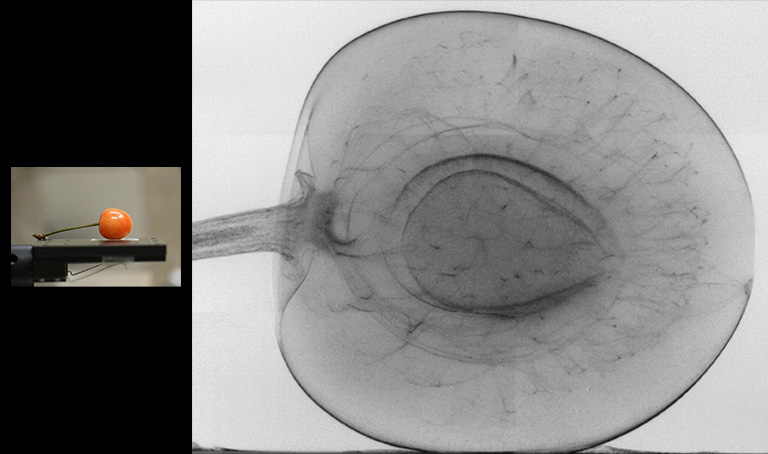
Courtesy of Wataru Yashiro, International Center for Synchrotron Radiation Innovation Smart (SRIS), Tohoku University
This may be closer to a request rather than an improvement, but, if possible, we would like to see a wider field of view while maintaining the current high resolution and sensitivity. As mentioned earlier, a broader field of view would allow us to image larger objects, which in turn expands the range of research targets. Increasing the scope of what can be imaged means taking one step closer to solving the mysteries of the natural world. We conduct our research with a strong sense of mission to contribute to society in this way, so we would greatly appreciate your support through advancements in research instruments and technologies.
Future research outlook
- Could you tell us about your future research prospects?
Our ultimate goal is to achieve “the world’s highest-sensitivity imaging and capture the most beautiful images in the world.” There are several approaches to high-resolution X-ray imaging, and currently, the two mainstream methods worldwide are the diffraction grating interferometry method and the propagation-based method. Both have the potential to deliver the highest sensitivity imaging, but we believe there is still room for improvement. To fully realize this goal, we ultimately aim to acquire X-ray holography, which involves directly capturing, recording, and visualizing phase information. We plan to continue developing technologies toward this objective.
As these technologies advance and enable the acquisition of more information, previously unseen details will become visible, paving the way for progress in data science. For example, identifying factors that determine the strength of concrete or metal could lead to the development of stronger materials. Similarly, distinguishing plant varieties at the structural level could support breeding improvements and species preservation. Through science, we aim to protect and nurture the resources of our world, contributing to the advancement of various industries.
We hope your company will continue to provide cameras with unmatched performance to support our ongoing challenges.
Researcher profile

Wataru Yashiro
International Center for Synchrotron Radiation Innovation Smart (SRIS), Tohoku University
2000 Department of Applied Physics, School of Engineering, The University of Tokyo, Ph.D. in Engineering
2000 The Japan Society for the Promotion of Science (JSPS), Research Fellowships for Young Scientists
2001 The National Institute of Advanced Industrial Science and Technology (AIST), Research Fellowships for Young Scientists
2004 The National Institute for Materials Science (NIMS), Research Fellowships for Young Scientists
2004 Department of Advanced Materials Science, Graduate School of Frontier Sciences, The University of Tokyo, Assistant Professor
2012 Institute of Multidisciplinary Research for Advanced Materials, Tohoku University, Associate Professor
2020 Institute for Chemical Research, Kyoto University, Visiting Associate Professor (Concurrent Appointment)
2021 Institute of Multidisciplinary Research for Advanced Materials, Tohoku University, Professor (Concurrent Appointment)
2021 Department of Finemechanics, Graduate School of Engineering, Tohoku University, Professor (Concurrent Appointment)
2022 Department of Applied Physics, Graduate School of Engineering, The University of Tokyo, Designated Visiting Professor (Concurrent Appointment)
2025 Graduate School of Dentistry, Tohoku University, Professor (Concurrent Appointment)
*The content presented on this page is based on an interview conducted in September 2025.
Related product
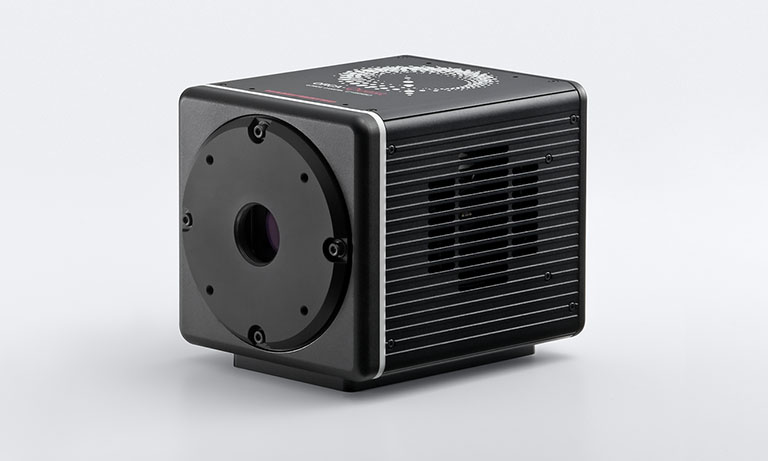
The ORCA-Quest 2 is a new qCMOS® camera, the successor to the ORCA-Quest with further advances such as faster readout speeds in extremely low-noise scan mode and increased sensitivity in the ultraviolet region.
Other case studies
- Confirmation
-
It looks like you're in the . If this is not your location, please select the correct region or country below.
You're headed to Hamamatsu Photonics website for JP (English). If you want to view an other country's site, the optimized information will be provided by selecting options below.
In order to use this website comfortably, we use cookies. For cookie details please see our cookie policy.
- Cookie Policy
-
This website or its third-party tools use cookies, which are necessary to its functioning and required to achieve the purposes illustrated in this cookie policy. By closing the cookie warning banner, scrolling the page, clicking a link or continuing to browse otherwise, you agree to the use of cookies.
Hamamatsu uses cookies in order to enhance your experience on our website and ensure that our website functions.
You can visit this page at any time to learn more about cookies, get the most up to date information on how we use cookies and manage your cookie settings. We will not use cookies for any purpose other than the ones stated, but please note that we reserve the right to update our cookies.
1. What are cookies?
For modern websites to work according to visitor’s expectations, they need to collect certain basic information about visitors. To do this, a site will create small text files which are placed on visitor’s devices (computer or mobile) - these files are known as cookies when you access a website. Cookies are used in order to make websites function and work efficiently. Cookies are uniquely assigned to each visitor and can only be read by a web server in the domain that issued the cookie to the visitor. Cookies cannot be used to run programs or deliver viruses to a visitor’s device.
Cookies do various jobs which make the visitor’s experience of the internet much smoother and more interactive. For instance, cookies are used to remember the visitor’s preferences on sites they visit often, to remember language preference and to help navigate between pages more efficiently. Much, though not all, of the data collected is anonymous, though some of it is designed to detect browsing patterns and approximate geographical location to improve the visitor experience.
Certain type of cookies may require the data subject’s consent before storing them on the computer.
2. What are the different types of cookies?
This website uses two types of cookies:
- First party cookies. For our website, the first party cookies are controlled and maintained by Hamamatsu. No other parties have access to these cookies.
- Third party cookies. These cookies are implemented by organizations outside Hamamatsu. We do not have access to the data in these cookies, but we use these cookies to improve the overall website experience.
3. How do we use cookies?
This website uses cookies for following purposes:
- Certain cookies are necessary for our website to function. These are strictly necessary cookies and are required to enable website access, support navigation or provide relevant content. These cookies direct you to the correct region or country, and support security and ecommerce. Strictly necessary cookies also enforce your privacy preferences. Without these strictly necessary cookies, much of our website will not function.
- Analytics cookies are used to track website usage. This data enables us to improve our website usability, performance and website administration. In our analytics cookies, we do not store any personal identifying information.
- Functionality cookies. These are used to recognize you when you return to our website. This enables us to personalize our content for you, greet you by name and remember your preferences (for example, your choice of language or region).
- These cookies record your visit to our website, the pages you have visited and the links you have followed. We will use this information to make our website and the advertising displayed on it more relevant to your interests. We may also share this information with third parties for this purpose.
Cookies help us help you. Through the use of cookies, we learn what is important to our visitors and we develop and enhance website content and functionality to support your experience. Much of our website can be accessed if cookies are disabled, however certain website functions may not work. And, we believe your current and future visits will be enhanced if cookies are enabled.
4. Which cookies do we use?
There are two ways to manage cookie preferences.
- You can set your cookie preferences on your device or in your browser.
- You can set your cookie preferences at the website level.
If you don’t want to receive cookies, you can modify your browser so that it notifies you when cookies are sent to it or you can refuse cookies altogether. You can also delete cookies that have already been set.
If you wish to restrict or block web browser cookies which are set on your device then you can do this through your browser settings; the Help function within your browser should tell you how. Alternatively, you may wish to visit www.aboutcookies.org, which contains comprehensive information on how to do this on a wide variety of desktop browsers.
5. What are Internet tags and how do we use them with cookies?
Occasionally, we may use internet tags (also known as action tags, single-pixel GIFs, clear GIFs, invisible GIFs and 1-by-1 GIFs) at this site and may deploy these tags/cookies through a third-party advertising partner or a web analytical service partner which may be located and store the respective information (including your IP-address) in a foreign country. These tags/cookies are placed on both online advertisements that bring users to this site and on different pages of this site. We use this technology to measure the visitors' responses to our sites and the effectiveness of our advertising campaigns (including how many times a page is opened and which information is consulted) as well as to evaluate your use of this website. The third-party partner or the web analytical service partner may be able to collect data about visitors to our and other sites because of these internet tags/cookies, may compose reports regarding the website’s activity for us and may provide further services which are related to the use of the website and the internet. They may provide such information to other parties if there is a legal requirement that they do so, or if they hire the other parties to process information on their behalf.
If you would like more information about web tags and cookies associated with on-line advertising or to opt-out of third-party collection of this information, please visit the Network Advertising Initiative website http://www.networkadvertising.org.
6. Analytics and Advertisement Cookies
We use third-party cookies (such as Google Analytics) to track visitors on our website, to get reports about how visitors use the website and to inform, optimize and serve ads based on someone's past visits to our website.
You may opt-out of Google Analytics cookies by the websites provided by Google:
https://tools.google.com/dlpage/gaoptout?hl=en
As provided in this Privacy Policy (Article 5), you can learn more about opt-out cookies by the website provided by Network Advertising Initiative:
http://www.networkadvertising.org
We inform you that in such case you will not be able to wholly use all functions of our website.
Close